Status: 68000: running on FPGA, cycle-accurate, boots Linux. 68020–68040: on request.
Motorola 68000 family (68000–68040) replacement on FPGA
We build FPGA replacements for the Motorola 68000 family (68000–68040) that run your existing software unchanged.
Your options
Where it's still running
- Avionics
- Defense
- Industrial control
- Telecom
Remanufactured stock
Buys time, but the parts still come from a fab that will stop making them.
Rewrite and recertify
Porting the software to a new processor means redesign and recertification, which take years.
Compatible FPGA replacement
Keeps the binaries, the board and the qualification you already have.
What makes it hard
68020 onward use a 32-bit bus; the 68040 integrates an FPU, an MMU and on-chip instruction and data caches, and software may rely on all three. Earlier systems pair the CPU with a 68881/68882 FPU.
How we approach it
Silicon distillation: we redesign the microarchitecture from public documentation, check it cycle by cycle against a reference model, then diff it against the original chip on an FPGA rig. We deliver it as a core for a new FPGA design, or as a drop-in module that fits the original socket.
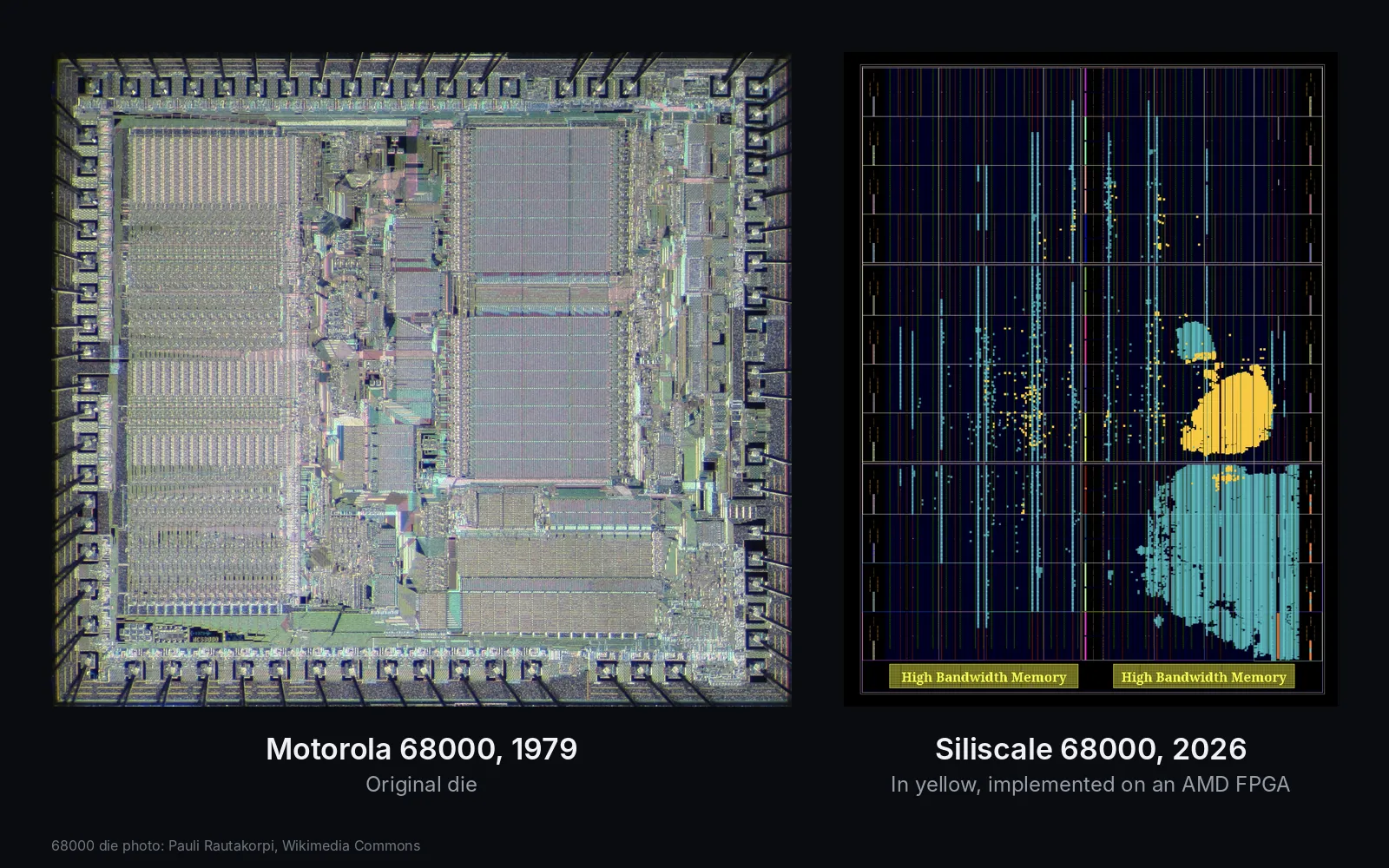
First through: the Motorola 68000
- Full 68000 instruction set from the Programmer's Reference Manual implemented
- 237 cycle-accurate tests and Dhrystone passing on the FPGA
- Linux (no-MMU) booting to a shell, in real time

Frequently asked questions
Will our software run unchanged?
Yes. The core implements the original instruction set, so existing binaries run as they are. Where software depends on exact timing, the core is made cycle-accurate.
Can you match the original timing?
Yes, with a cycle-accurate implementation where software depends on it.
Discuss your project
Share the target, interfaces, and timeline. We’ll tell you what we’d take on first.